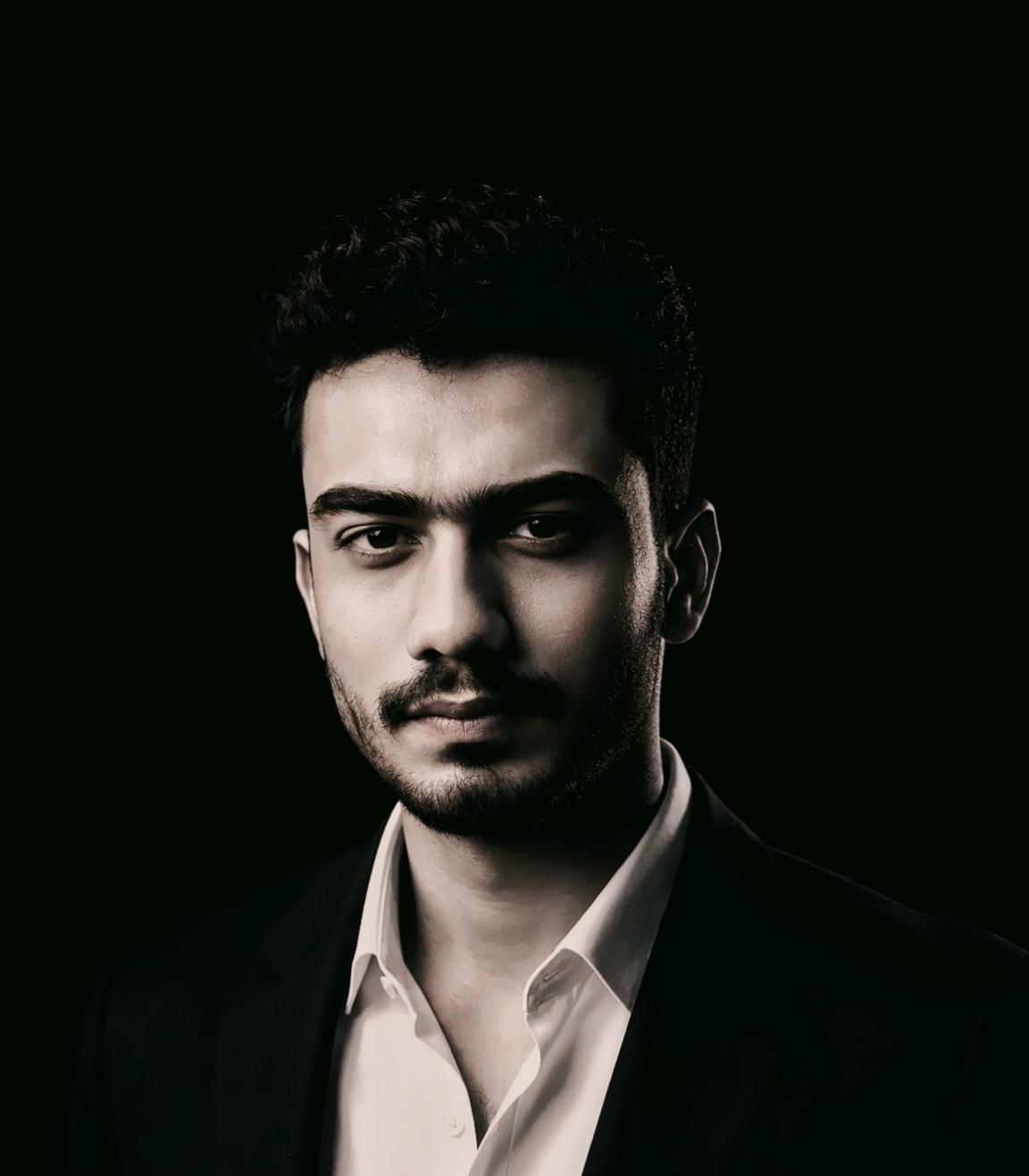
Shivansh Malviya
Teleporting...

Shivansh Malviya Applied Quantum Physicist

Engineering post-quantum security and hybrid infrastructure.

I design PQC crypto-agility frameworks, simulate quantum-secure networks, and evaluate hybrid quantum architectures against hard engineering constraints.

HPC
C++, Python & sparse
matrix solvers
EVAL
Falsifiable benchmarks
& failure diagnostics
ARCH
Federal threat models
& deployment constraints
About

Physics foundations, engineering constraints.

My interest in Physics became apparent in the middle school itself when the subjects hadn't even trifurcated into bio/chem/phy. With a deep fascination with outer-space and the sub-atomic world, I leaned towards Cosmology and Particle Physics - which remain my interest till day and absorb some of my free time. I wanted to be a wave: indulged in multiple domains and fields at the same time; but life forced me to be a particle, and so I chose Quantum Tech.

I approach quantum information science through the lens of computational physics, systems engineering, and adversarial research. While theoretical protocols assume ideal conditions, real-world deployment requires navigating noise, hardware limitations, and physical security vulnerabilities. To obtain the middle ground between the threat of quantum computers and the obstacles to it, I decided to dedicate my time to PQC: securing against HNDL threat, as well as designing the very strategies of building up the talent pool.

Experience

Selected experience

Jun 2025 to Present
Applied Quantum Physicist
Third Ray Inc. (Remote)
Authored five-phase PQC migration roadmaps; designed a falsifiable ML-KEM side-channel evaluation framework; audited hybrid SchNet + VQC models; and assessed quantum methods for power-grid workloads. Produced technical reports and decision frameworks for engineering and stakeholder use.
PQC migrationML-KEM / SCAHybrid QMLQuantum feasibility
Jan to Nov 2024
MS Thesis Researcher
IIT Indore & IISER Pune
Architected a full-stack numerical simulation pipeline in Python and Qiskit. Integrated physical-layer quantum noise models directly into classical network scheduling algorithms, bridging the gap between theoretical cryptography and operational traffic constraints.
Python / QiskitPipeline architectureSystems integrationNumerical modeling
May to Jul 2023
Graduate Researcher
Harish-Chandra Research Institute
Implemented sparse-matrix Hamiltonian construction and ARPACK iterative solvers in C++ for transverse-field Ising chains up to N=22. Authored custom, dependency-free partial trace routines to resolve high-performance computing (HPC) compilation failures, and verified Wootters concurrence scaling at J/h=1.
Many-body physicsSparse matricesARPACKC++
Selected work

Quantum systems, migration, and model building

Selected technical work across quantum ML, secure networking, post-quantum migration, and research communication.

Materials Informatics / Hybrid QMLResearch Poster

QML for 2D Materials Property Prediction

Hybrid SchNet + VQC framework over a 6,351-entry 2DMatPedia corpus (≈4,500 valid bandgap labels); R² ≈ 0.782, MAE = 0.439 eV (single-fold baseline) achieved after resolving target-leakage in spatial normalizers.

Research posterFailure diagnosticsVQCSchNetPennyLane
Protocol + Network SimulationMS Thesis

QKD Resource Allocation in Optical Networks

MS thesis linking BB84 key negotiation under noise and eavesdropping with adaptive routing and quantum-resource allocation on a 14-node optical network.

ThesisNSFNETAdaptive routingQKRA heuristicsBB84Qiskit
Migration Strategy

PQC Migration Roadmaps

Authored a white paper and five-phase migration roadmaps intended for federal agency deployment scenarios, contextualized within the $7.1B federal migration scope through Mosca's Theorem risk prioritization, hybrid transition design, and crypto-agility.

Crypto-agilityMosca's TheoremHybrid transitionCBOM / CycloneDX
Power-Grid AnalyticsDecision Framework

Quantum Power-Grid Analytics

Authored a literature-grounded white paper and decision framework for power-grid quantum adoption, mapping nine algorithm families to grid workloads and screening them against QRAM, noise, and hybrid-workflow constraints.

White paperGrid workloadsHardware constraintsAlgorithm screening
Evaluation DesignResearch Direction

PQC Side-Channel Analysis

Designed a falsifiable framework for testing quantum-kernel key recovery against strong classical baselines, with staged datasets, key-rank benchmarks, and explicit claim gates. Retained as an independent research direction.

Side-channel analysisML-KEM / KyberQuantum kernelsKey-rank evaluation
Quantum Readiness StrategyDelivered White Paper

Quantum Workforce Development

Authored and delivered a power-sector readiness strategy linking a three-tier National Quantum Grid Academy to staged PQC, sensing, and benchmark-gated hybrid-computing adoption.

White paperCurriculum architecturePQC migrationBenchmark-gated computingQuantum-sensing pilots
Editorial & Verification

Research Communication

Evidence-first research communications for Quantum Buzzz, combining editorial review, citation forensics, and hype reduction before publication.

AuditingEditorial workflowCitation forensicsTechnical review
Many-Body PhysicsGraduate Researcher

Concurrence at Quantum Phase Transitions

C++ sparse Hamiltonian solvers and custom partial-trace simulations tracking ground-state entanglement (Wootters concurrence) near the quantum critical point ($J/h = 1$) for spin chains up to N=22 spins.

Entanglement scalingQPTSparse matricesC++ARPACK solvers
Focus

Applied research under operational constraints

I turn quantum theory, standards, and literature evidence into simulations, decision frameworks, migration roadmaps, and deployment-aware technical strategies.

QKD Resource Allocation

Built and evaluated a two-layer thesis simulation connecting BB84 security behavior to adaptive routing and wavelength/time-slot allocation on the 14-node NSFNET topology. Compared three allocation policies through QBER, SKR, SRCR, TUR, and NSP after correcting indexing and logic defects in the analysis pipeline.

PQC Migration & Crypto-Agility

Turned post-quantum standards and deployment constraints into a confidential white paper and five-phase migration roadmaps intended for federal agency deployment scenarios, addressing the $7.1B federal migration scope through Mosca's Theorem risk prioritization, hybrid transition design, and crypto-agility.

QML for Materials Models

Built and audited three hybrid quantum-classical architecture directions for bandgap prediction on a 6,351-entry 2DMatPedia-derived corpus. Diagnosed collapse-to-mean and target-leakage failure modes, then established a verified SchNet + VQC single-fold baseline of R² ≈ 0.782.

Power-Grid Quantum Feasibility

Authored a white paper and decision framework for power-grid quantum adoption, separating near-term hybrid pilots from immature approaches using hardware limits, QRAM data-loading constraints, classical baselines, and end-to-end advantage criteria.

Quantum Workforce & Curriculum (QGA)

Sole-authored and delivered a power-sector readiness strategy built around a three-tier National Quantum Grid Academy and staged Defend–Sense–Compute adoption. Defined role-specific curricula, regional delivery, workforce KPIs, benchmark-gated pilot templates, governance, risk mitigation, and funding pathways.

Skills

Research capabilities & technical stack

Quantum Modeling & Simulation

Qiskit and PennyLane workflows for variational circuits and VQC/QSVM prototypes, plus VQE/QAOA and Hamiltonian-simulation framing.

Secure Quantum Communications

BB84 security simulation, QBER/SKR analysis, QKD-secured optical-network modeling, and adaptive key-resource allocation.

PQC Transition & Evaluation

ML-KEM, ML-DSA, and SLH-DSA families; CBOM-style discovery, HNDL risk, crypto-agility, migration planning, and side-channel assessment.

Scientific Computing & Numerical Methods

Python, NumPy, SciPy, Pandas, Matplotlib, Jupyter, C++, sparse methods, Lanczos diagonalization, and high-precision numerical verification.

ML Modeling & Diagnostics

PyTorch, scikit-learn, SchNet/GNN workflows, hybrid model integration, baseline comparisons, leakage checks, and failure-mode diagnosis.

Quantum Feasibility & Benchmark Design

Mapping operational workloads to candidate quantum methods, then defining classical baselines, pilot metrics, maturity gates, and end-to-end advantage criteria.

Reproducible Research Workflow

Git/GitHub, Jupyter, LaTeX, structured evidence review, reproducible notebooks, technical reports, and verification-focused documentation.

Technical Strategy & Communication

Migration roadmaps, risk analyses, decision frameworks, research communications, and audience-aware technical explanations.

Web Prototypes & Delivery

JavaScript, CSS, React, Vite, Tailwind, Vercel, and lightweight automation for communicating and shipping technical work.

Outside the lab

Exploring the intersections of music, literature, systems thinking, philosophy, and system architecture experiments.

Exams & certs Armed forces Guitar Philosophy Video games
State Convenor Think India, Western Maharashtra
Dec 2022 - Dec 2023
Delegation Protocol Lead Think India National Convention
Nov 2022
Contact

Get in touch

Open to quantum computing research roles, PhD opportunities, technical discussions, and collaborations in PQC, QML, hybrid quantum-classical materials modeling, and infrastructure-facing quantum work.